
Challenge #1 – C53, Spindle Galaxy in Sextans
| Target | Type | R. A. | Dec. | Constellation | Magnitude | Size |
| C53 (NGC 3115) | Lenticular Galaxy | 10h 05m 14s | -07° 43′ 07″ | Sextans | +9.1 | 7.1×3.0 arcmins |
Overview
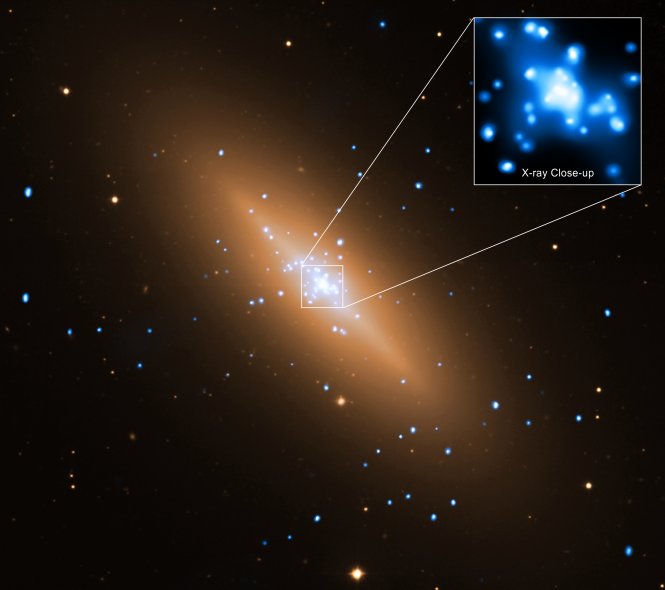
It can be a little confusing to see this Spindle Galaxy when you know the Spindle Galaxy to be M102 but it’s true: we’ve managed to give two different galaxies the same name, even though we’ve not named more than about thirty of them in total.
William Herschel discovered this world of stars that’s about 32 million light-years away from us in 1787. It’s a lenticular galaxy with a brighter central bulge but no visible arms. We’re seeing it almost exactly edge-on, so it may well have a spiral that would be visible from a different location. This is also the reason that it’s wrongly classified as an elliptical galaxy in some locations.
It’s an old galaxy, which we know because the dust and gas of its original accretion disc has largely disappeared, so star formation here has practically come to an end.
At the center of this galaxy is a supermassive black hole with a mass of two billion suns, making it the closest billion-mass black hole to Earth that we’ve discovered.
Finder Charts
The first sky chart, from SkySafari 6, shows the view looking south at 10 pm in the middle of March. The moon and planets are not shown and stars are only shown to magnitude 5.0.
Orion, the Big Dipper (Plough) and the Sickle asterism in Leo are all highlighted to make it easier to find the small constellation of Sextans. At this time of year, the galaxy is midway between the southeast horizon and zenith (overhead).

The bottom two stars of the Sickle asterism point directly at the triangular shape of Sextans. Alpha Sextantis, the brightest star in that constellation, is easily visible to the naked eye under a dark sky.
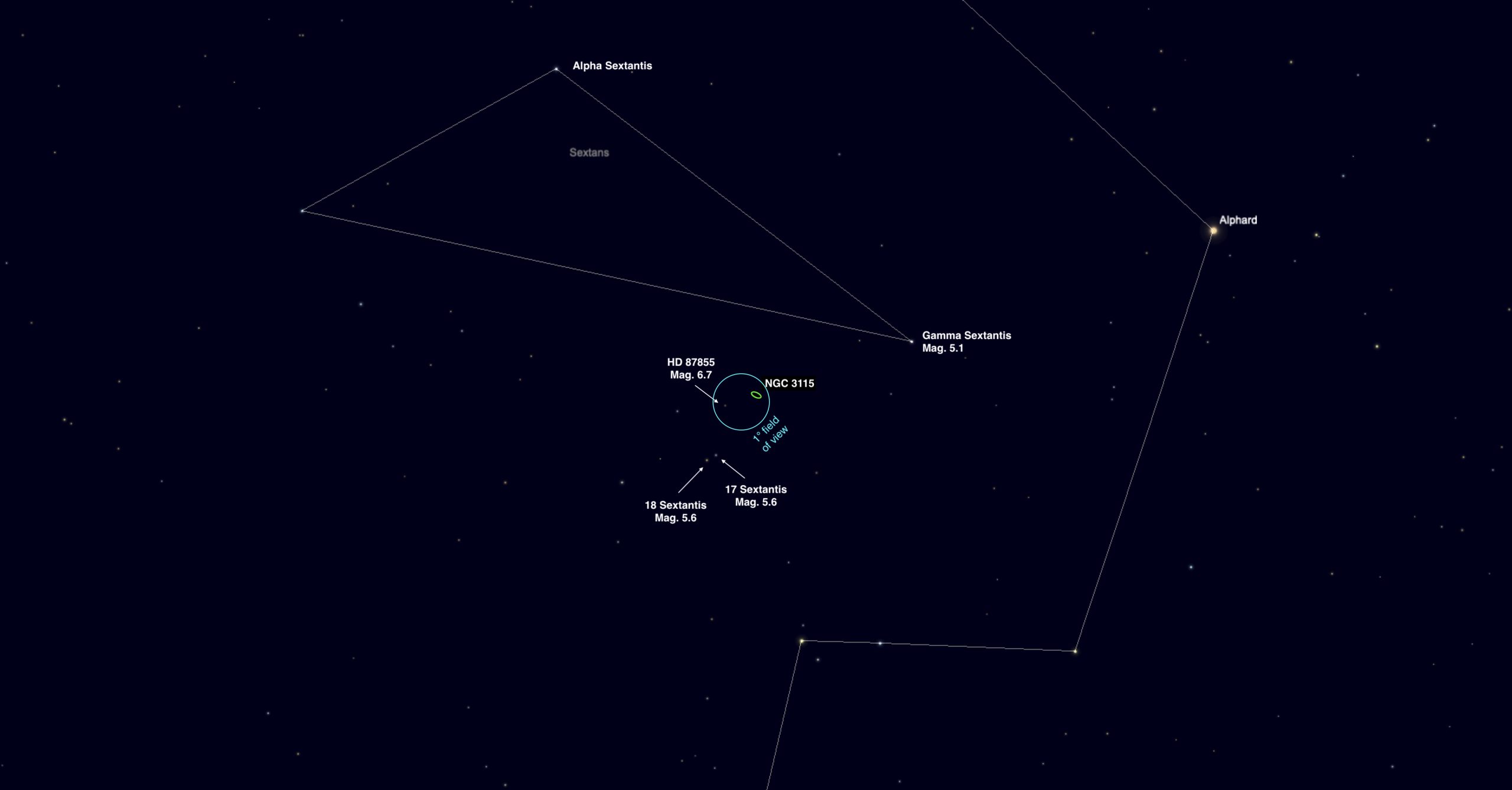
The Spindle galaxy is closest to another point on Sextans’ triangle, as we’ll see in the next chart.

This last finder chart shows stars to magnitude seven. These are easily visible in magnifying finderscopes and binoculars.
Thankfully we have stars near Gamma Sextantis that are visible to the naked eye. 17 and 18 Sextantis both shine at magnitude 5.6. Use these to locate HD 87855, which shines fainter at magnitude 6.7. With this star in your wide field of view eyepiece, you’ll also take in the sight of C53.
Now you’ve found this elongated galaxy, what should you expect to see?
Individual Telescope Views
The following views will help you find C53 in different telescope types by presenting the images as your telescope will show them. The first image is with a black sky and white stars, the second picture is the same image but presented in inverse monochrome. Black stars on a white background is often easier to use at the telescope. Each image can be clicked on for a full-screen version. Stars are shown to magnitude 10.0 and the stars 17 and 18 Sextantis are visible in each view. The ring is a 1° field of view and the brightest star inside it is HD 87855.
Upright View – This is what your eyes see unaided and through a reflex or red-dot finderscope
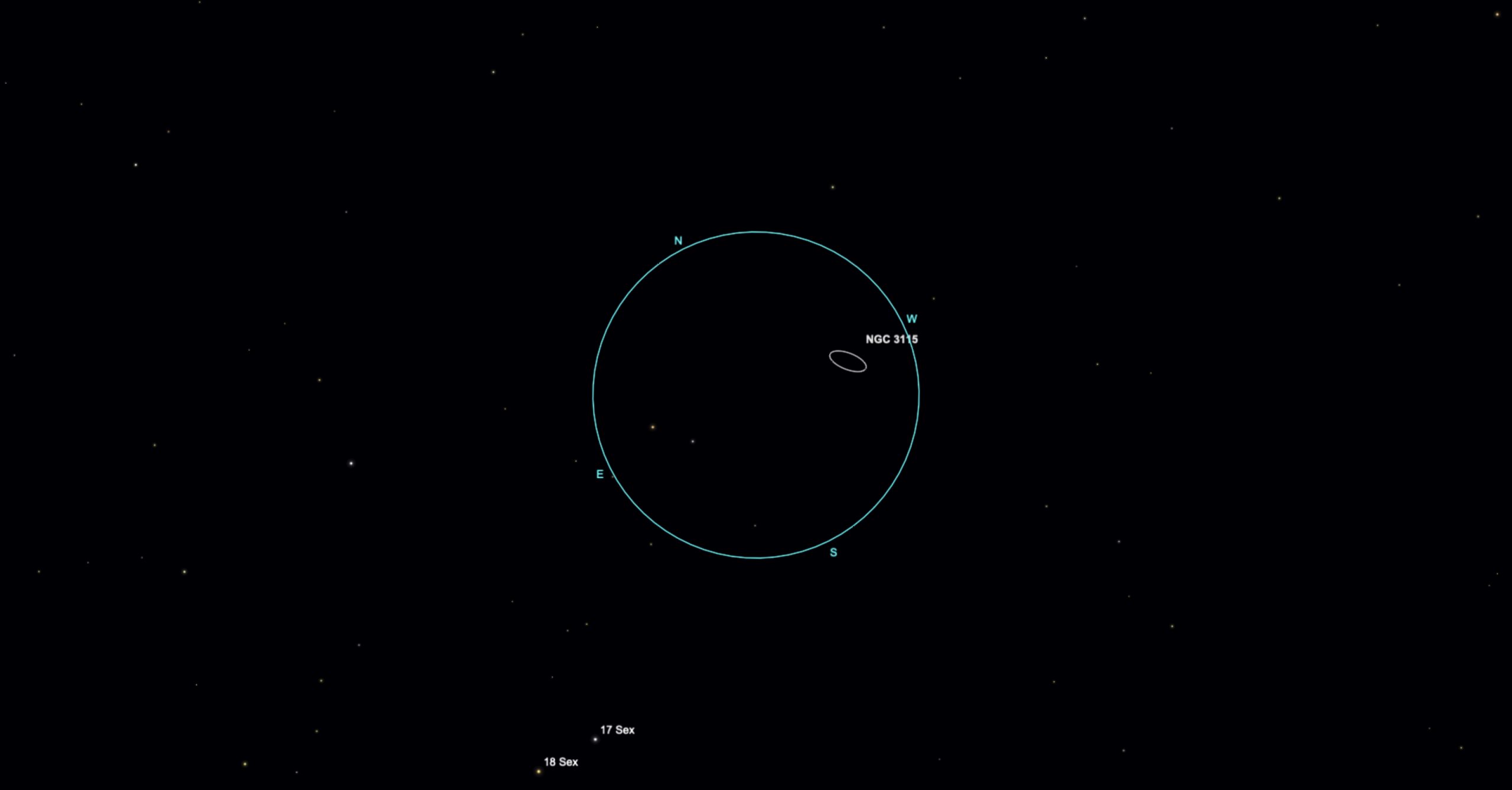
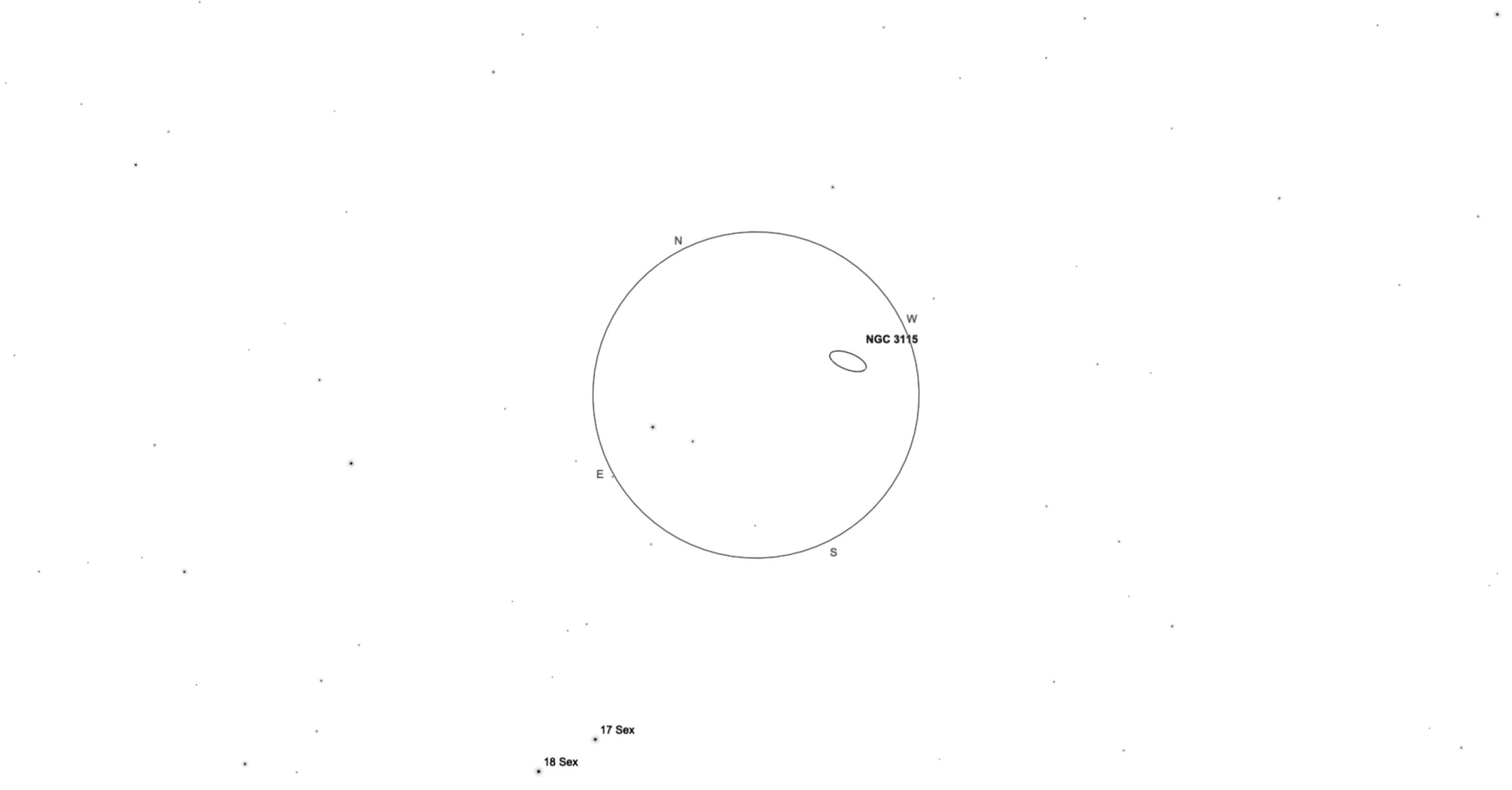
Upside-down view – This is what reflectors and magnifying finders show, and refractors / Cassegrains without a star diagonal
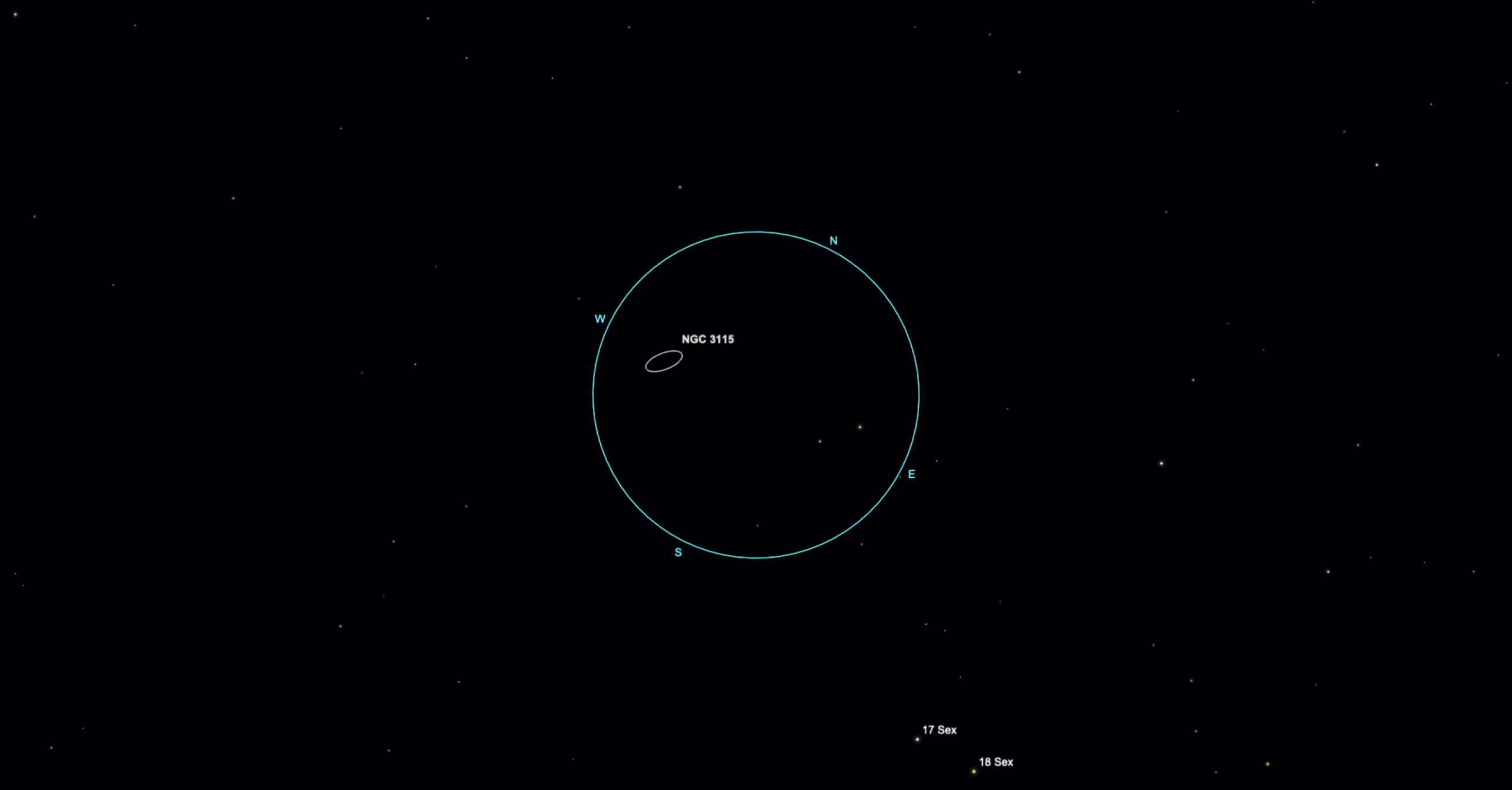
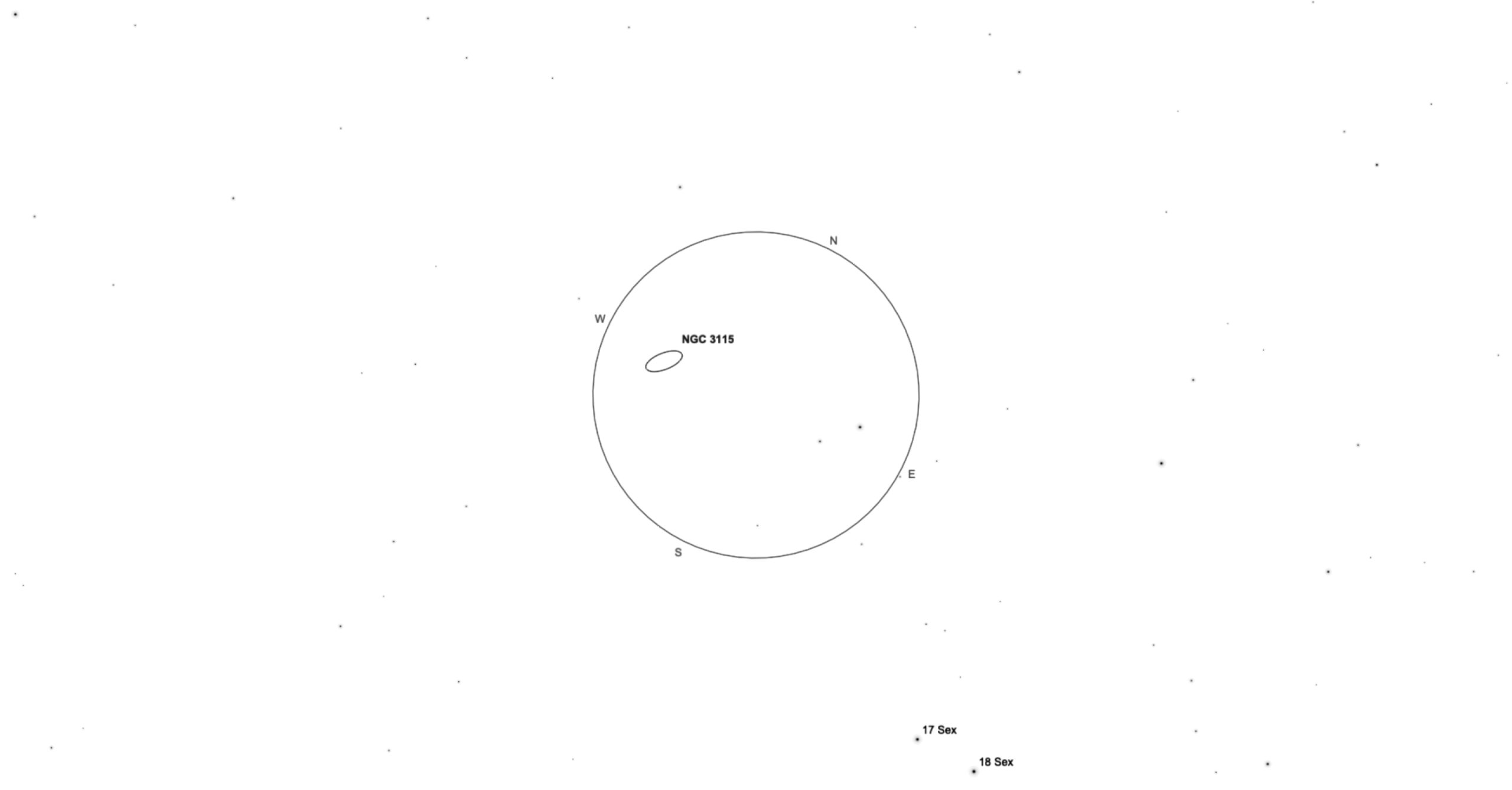
Mirrored View – Refractors and Cassegrain models with a star diagonal show this view
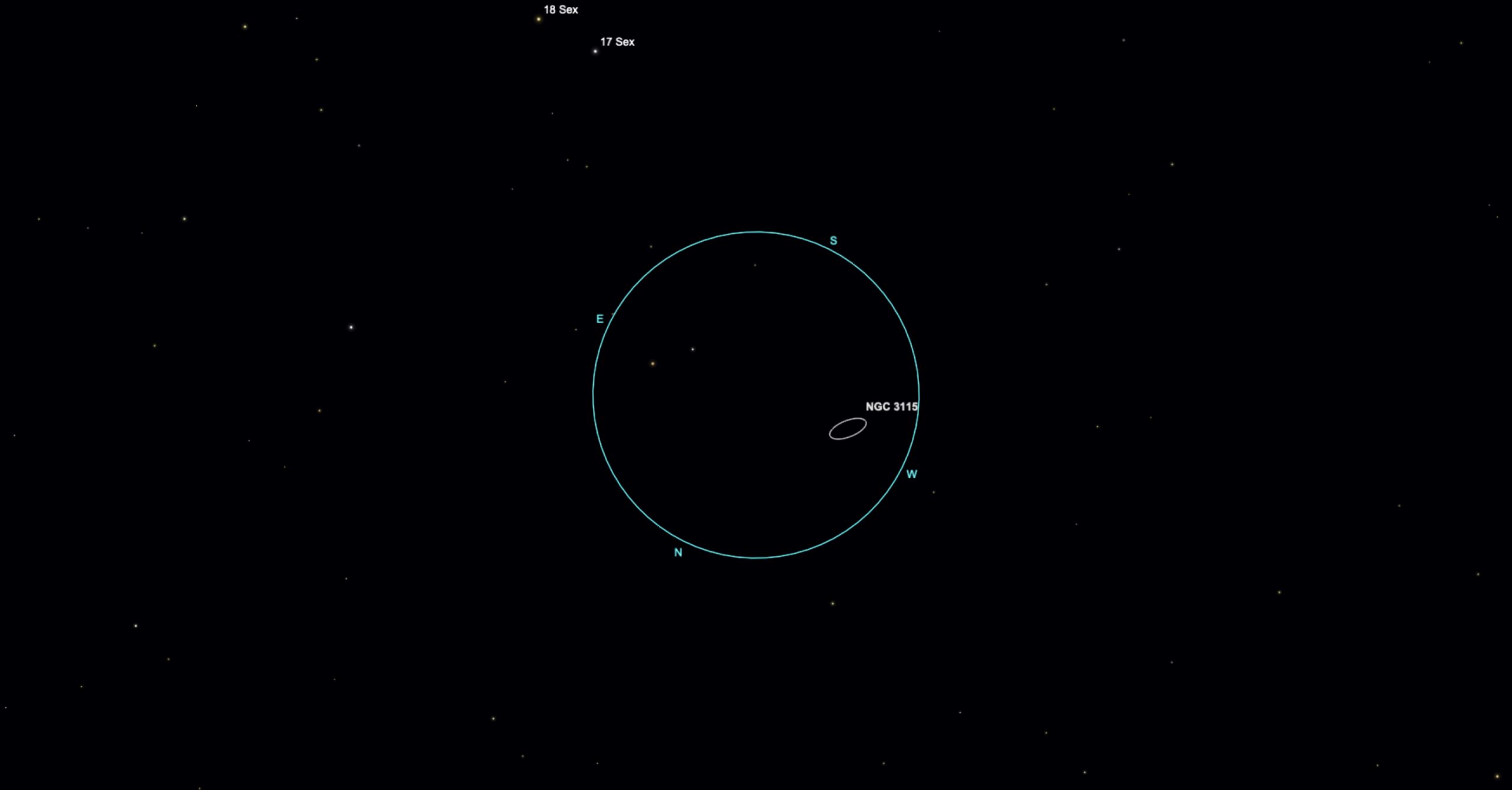
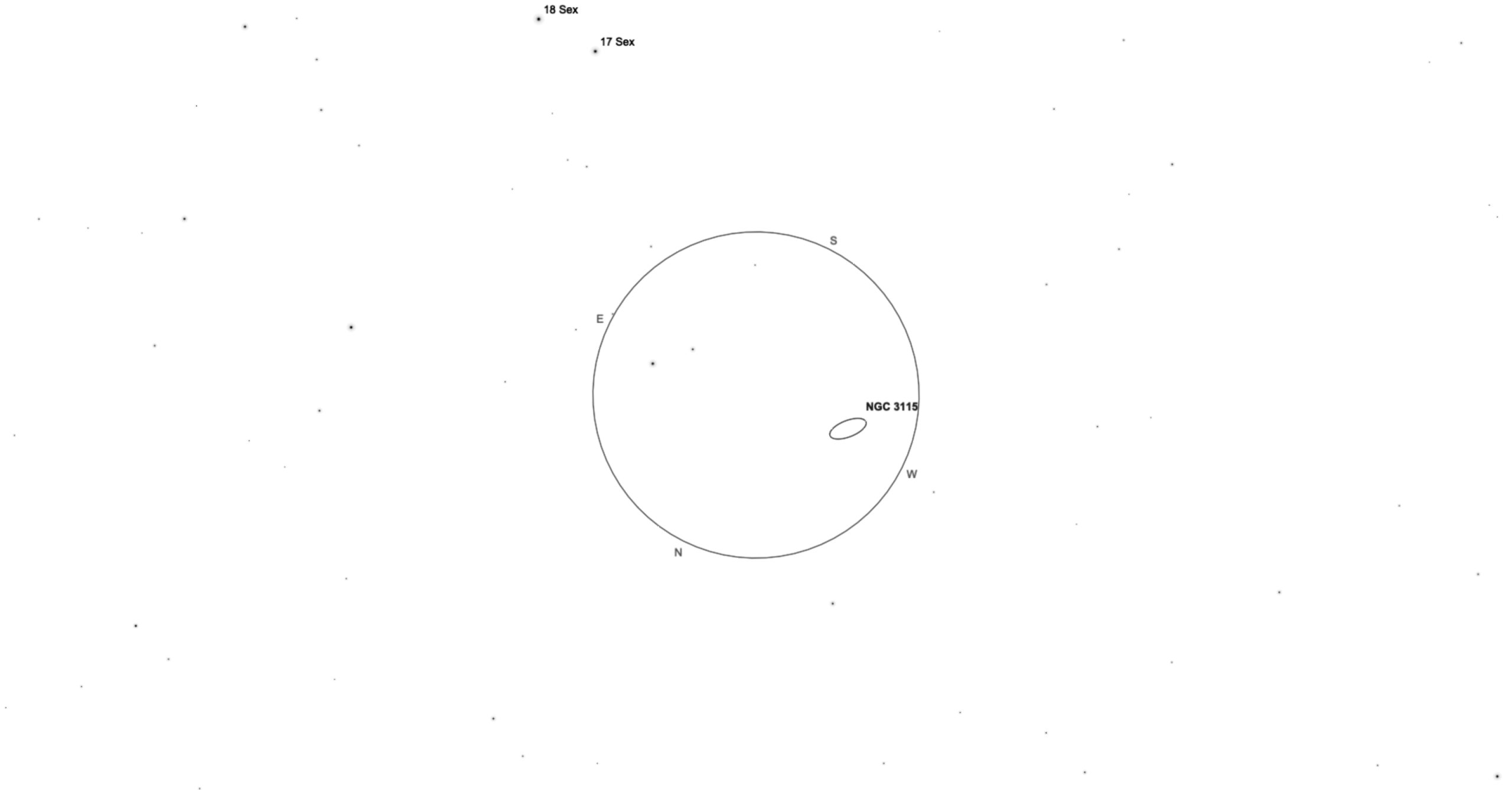
Observation
As with most galaxies, the Spindle is best observed under dark skies. In fact, when you do, this other world is prominent enough to be enjoyed at low magnification in a relatively small telescope.
You’ll be able to clearly see why this galaxy earned its name; the long, thin spindle shape is obvious to see.
The central area bulges out in a dense halo of light and shows us the home of that supermassive black hole from earlier.
The Spindle will take higher magnification and this allows us to enjoy more detail in sharper relief, especially around the core. You’ll also observe a halo of light around it higher magnification, making this one of the best Caldwell objects to observe.
PDFs for Printing
Each of the star maps above is reproduced as a pdf below. Each star map has a number in [square brackets] beneath it which corresponds to the file number below. If you want image [C53-1], for example, click the ‘download’ button next to it below and you’ll be able to open it as a printable pdf.